Thomas Leonard, an innovator in the coaching realm, introduced a concept that shook the foundations of productivity: tolerations. Imagine a whopping 80% of your energy potentially squandered on these pesky distractions. For an entrepreneur like yourself, that energy could be better invested in scaling your business’s growth.
Picture tolerations as grains of sand grinding away at the gears of your entrepreneurial engine. Tiny? Yes. But detrimental nonetheless. These vexations dull your zest, obscure your vision, and confuse your priorities. And you deserve better.
Encountering Tolerations Everywhere: A Common Experience
Tolerations lurk everywhere. At home, a peeling paint job or a window chipped during a lively childhood game might catch your eye and nag at you. At work, cluttered desks and disorganized files might be your silent adversaries. Tolerations manifest as the clutter in your car or the unhealthy eating habits formed in the race against time.
In business, tolerations often arise in the form of missed timelines, unrelenting stress, subpar performance from others, and encountering demanding clients who may not align with the core values or offerings of our enterprise
Certainly, we are surrounded by tolerations, but what compels us to persist in tolerating them? The desire to transform ineffective energy utilization into something more powerful — business growth.
Energize Your Business Growth: Fuel Your Expansion
Bidding adieu to the seemingly trivial yet persistent nuisances cultivates joy and propels business success to new heights. It’s a liberation that lets us focus our energy and resources on strategic initiatives, fueling growth and fostering a more resilient organization.
We create space for creativity, innovation, and enhanced productivity by liberating ourselves from the burdensome weight of minor frustrations.
Heighten Awareness: Pay attention. Observe yourself. What gets under your skin? Raise your antennae. But don’t be too astonished by the magnitude of energy you’ve poured into these tolerations.
List Them Out: Maintain a list over the coming days — every single pet peeve, whether large or small.
Gauge the Costs: Weigh out the hard costs (like hiring a bookkeeper) against the soft costs (the energy you lose stressing over late invoices and reconciling your accounts.).
Target and Eliminate: Choose the most draining toleration and axe it from your life. And don’t just cut. Dig out the roots to prevent them from sprouting again. Look for the source of the toleration!
Rinse and Repeat: Tackle each toleration until your list is clear, your energy reclaimed, and your attention refocused.
Freeing yourself from these shackles not only brightens your mood but also turns you into a magnetic force of positivity. You’ll have boundless energy to inject into growing your enterprise.
Ultimately, isn’t this the very essence of entrepreneurial pursuit? With clarity on your journey towards exhilarating business expansion, the decisive step forward awaits.
Join our community of driven entrepreneurs today for inspiration, support, and guidance to skyrocket your success. Because together, we transform challenges into victories and tolerations into triumphs.
As an entrepreneur, have you ever felt the creeping sense of overload inching its way into your mind and body? You’re not alone. Entrepreneur Fatigue is the silent killer of productivity and business growth. But how do you battle this unseen adversary and reclaim the vigor needed to pursue your entrepreneurial dreams?
The High Stakes of Ignoring Fatigue
Imagine steering a ship through a storm with bleary eyes — that’s what managing a business exhausted feels like. Think about it; when was the last time running on fumes led you to your finest hour? The answer, I wager, would be never.
The crushing weight of fatigue doesn’t just dent your well-being; it cascades down to every facet of your business and personal life. Can you identify the telltale signs?
The irritability that snaps at a team member’s innocent question.
That mental fog when focus is imperative.
The clutter drowning your workspace… and your thoughts.
A simple distraction pulls you off course.
The lapse in memory when every detail counts.
Sound familiar?
These symptoms aren’t just inconvenient; they can be dire to your business growth. Missing a crucial deadline or alienating a valuable client can have serious repercussions. After all, in the fast-paced business world, one misstep can mean the difference between closing a deal and closing your doors.
The True Cost of ‘Business as Usual’
With fatigue, ‘business as usual’ is anything but profitable. It’s that insidious force that gives rise to stalled business growth and rash decisions. And while the hustle culture applauds those who burn the candle at both ends, we must ask ourselves: At what cost?
Breaking the Cycle
So, how do we dismantle this vicious cycle? How do we restore the balance not only in our businesses but in ourselves?
The simple prescription is this: Rest. Recharge. Refocus. Let’s explore these three R’s that can revolutionize your approach to entrepreneurial vitality:
Rest: The Foundation of Performance
It’s not about how many hours you put in but about the quality of those hours. Working smarter isn’t just a catchphrase; it’s a survival tactic. Could a short nap be the power-up you need to tackle the next challenge? It’s time to ditch the stigma around a midday pause.
Recharge: Cultivate Sustainable Energy
Consider it: when did you last take a day for yourself? Shift gears and take that vacation without a smidgen of guilt. Your business is shaped by the creativity and clarity that only come from a well-rested mind, not just hard work.
Refocus: Prioritize with Precision
Are you tackling tasks that align with your ultimate goals? Every action should be a stepping stone toward success. By eliminating the excess, by honing in on what truly matters, you not only mitigate fatigue but accelerate growth.
A Call to Action for the Weary Entrepreneur
This isn’t just a plea; it’s a rallying cry for sustainability in our business and personal lives. It’s time to forge a new path where well-being and success go hand in hand.
So ask yourself — are you ready to defeat Entrepreneurial Fatigue and step into a future where your health and your business thrive together?
The next time you’re too tired to pole-vault over a chalk mark, take two of these — Sneak in a nap. Grab a day off. Seize a long walk. Carve out a break — and call us in the morning!
Zoom. Zoom. Zoom. OMG! I love that famously-recognized Mazda commercial circa 2000. Little did we know at the time that the little ditty would personify our lives.
In 2009, Graeme Wood, Australian digital entrepreneur and philanthropist, wrote: “Change has never happened this fast before, and it will never be this slow again.“
Hold onto your hats!
There are moments (many of them) when growing our business feels like careening down a steep hill with failing brakes.
An accelerated pace of change ushers in an entire slew of complications. Who knew that a mere five years ago, we could say, for certain, our business model was set in stone? When conflicting headlines and confusing economic indicators are added, the future feels tentative.
What are entrepreneurs to do?
Put on the brakes? Play it safe? Hunker down until certainty returns? Anyone who survived the 2008 economic downturn or COVID knows first-hand the impact of uncertainty.
Admittedly, I can sometimes feel a little bit like Chicken Little running around clucking on how “the sky is falling.” Yet, I worry. (I’m German, so it’s in my DNA.) I worry especially for the small business owner who dedicates blood, sweat, and tears to growing their passion.
Complexity tests our skills to balance it all out. Do we have what it takes to adapt and transform our organizations? The real challenge is keeping pace. Staying relevant. Being competitive.
It is important to find the right balance between uncertainty and complexity, as this balance will determine our business success.
The time is NOW—not tomorrow—to take massive action to protect, optimize, and grow into the future.
The Entrepreneur’s Balancing Act
As you might guess, here are a few of my recommendations to get you started:
Purpose is essential. Today’s consumers want to do business with businesses of like values and purpose.Know your “why” to build trust and strengthen those relationships with your clients. Develop transparency of your core values to protect and promote your brand.
Clarify your business. If someone asks what business you are in, can you quickly—and clearly—say? Business lucidity is a must. It’s a real head-scratcher to answer the question, “What business am I in?” — particularly for professional service firms. However, it’s a journey in distinctiveness that is worth the ride.
Future vision. Knowing where you’re going beyond “a building lease for three years,” guides your direction and turns you into a wise, strategic decision-maker. Since you’re the curator of your dream, be sure it’s compelling to you.
Optimize business operations. Combining (wo)man and machine with integrating digital solutions increases productivity by more than 30%. This frees you and your people to focus on the most important priority—your clients.
Be bold. Be brave. You’ve got this! You’re smart and intuitive. Trust yourself—and your data—to help you take significant, courageous steps into a better tomorrow.
Invest in technology. Improve efficiencies and productivity. Leverage technology to drive consistency between what you say and what you deliver. A gap of any kind is detrimental to the future of your business.
Develop an adaptive mindset. Rather than perfect today, understand the complexity of your market to identify opportunities in your industry. Balance market trends with timely decision-making. A flexible mindset allows you to respond quickly to change so you can thrive—not merely survive.
Master strategic decision-making. It’s required in a complex ecosystem. Sharpen the “why, what, and how” of your decisions to accelerate growth.
Get connected. The more we connect, the quicker we learn. Get up to speed with technologies and methodologies to meet complex challenges and form new paths to growth. Tap into your community to help monitor changing environments. Maybe join our Mastermind for the Messy Middle! A supportive environment that promotes risk-taking.
Ask questions. The better the question. The better the answer. The better your business works.
Stay healthy. Building a business means working long, grueling hours and staying healthy—mentally, physically, and emotionally.
Navigating Turbulent Terrain
I love what the Entrepreneur of the Year award winner had to say: “There’s no point in doing anything other than to look for the opportunity in the crisis.“
Apparently, 67% of entrepreneurs agree! Pursuing new market opportunities during economic uncertainty is a winning strategy.
Navigating the balance of uncertainty and complexity as entrepreneurs is one of our greatest challenges and critical to our success. And yet, an open mind to learning, a healthy lifestyle, and focus and clarity are our best wayfinders.
_____________
Don’t let uncertainty stand in the way of achieving your dreams. Contact us today, and together we’ll create an actionable plan to ensure your business thrives!
Have you heard of the Messy Middle? Few entrepreneurs don’t realize it’s their everyday experience until they read the description. Suddenly it clicks — “That’s me!” These savvy individuals can discern symptoms, identify pain points, and empathize with other businesses experiencing the same predicament. Arriving at this moment of clarity for oneself is a game-changer. It shifts the focus from chaos to clarity, empowering entrepreneurs to take action toward a more progressive outcome.
The Messy Middle vortex, or stage two of business growth and development, is the natural progression following establishing your start-up foundation. You’ve proven your business model. Your marketing and sales funnels are functioning beautifully and creating a consistent stream of clients for your business. You are growing your team in numbers and skill. Essentially, you have successfully ironed out many of the kinks associated with your start-up and have created some sustainability and resilience in your systems.
Even so, revenue can be sluggish, anywhere between $350,000 and $1 million annually, depending on your industry and service. Despite the expansion of your team, the talent pool looks cloudy. Cash flow is shrinking. And the worst part is being swamped with day-to-day operations when all you really want to do is focus on growing or scaling your business.
Extended work hours, once believed to be temporary, are now permanent and no longer sustainable. There is no time to think—let alone the time needed to think strategically. (A different thinking skill, BTW, requiring some white space.) The inadequacies of one’s growth system become increasingly conspicuous.
The chaos of the Messy Middle often forces businesses to abandon their successful tactics, including accountability, needed to grow. Business life becomes all about extinguishing fires.
So, let’s talk about accountability—what it is and why it’s crucial for an entrepreneur, especially at this stage of business growth, and the common misconceptions about accountability.
This is NOT accountability!
Entrepreneurs and Accountability to Success Tactics
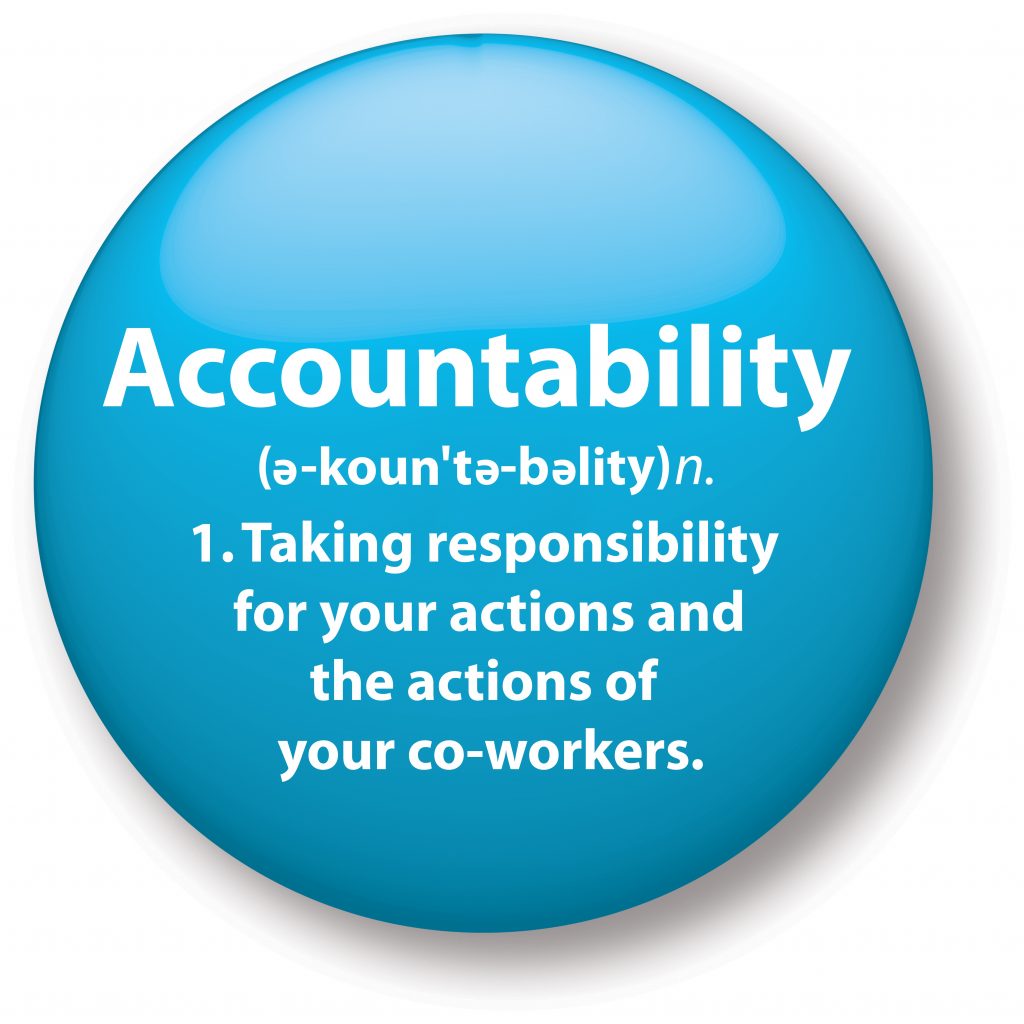
Webster defines accountability as “an obligation or willingness to accept responsibility or to account for one’s actions.” It refers to the responsibility and answerability of individuals or organizations for their actions, decisions, and outcomes.
For entrepreneurs, accountability is a slippery slope. Often strongly-driven entrepreneurs resist personal accountability. They often see it as a sign of weakness or failure. Or accountability can often be associated with micromanagement and excessive control, which stifles creativity and freedom.
And yet, in business, owner accountability is a crucial aspect of the growth process. It builds trust and credibility, promotes team engagement, enhances the business’s overall performance, and, most importantly, fosters a more disciplined approach to our decision-making. Holding ourselves accountable encourages critical thinking and helps us avoid impulsive decisions.
THIS is accountability!
Navigating the Messy Middle: How Accountability Helps Tackle Challenges
I’ve touched briefly upon entrepreneurs’ challenges during the Messy Middle stage, where things can become chaotic. Clarity and focus provided by accountability, whether to oneself, a mastermind group, an accountability coach, or a system, are paramount for rising above the noise. And its effectiveness is multifaceted.
Improved performance. Accountability promotes establishing clear goals and encourages entrepreneurs to strive for excellence, take consistent action, and achieve better results.
Strategic decision-making. Rather than making ad-hoc or impulsive decisions, entrepreneurs committed to accountability gather the relevant information and weigh the risks and benefits to ensure their choices are intelligent and thoughtful.
Enhanced trust and credibility. Stakeholders are more confident doing business with you knowing your word is your bond.
Engaged employees. Someonesaid, “The speed of the leader is the speed of the gang.” Members of your team will often mimic your behavior. So, credibility builds when you do what you say you’ll do.
Accelerated learning. Accountability encourages business owners to proactively address problems and challenges, which fosters accelerated learning and subsequent growth.
Sustainable growth. Entrepreneurial accountability ultimately builds a culture of responsibility, transparency, and ethical behavior that ensures the business operates in alignment with its values, which leads to greater resilience and long-term success.
Accountability: The Final Word
Accountability, in some form, is essential for business success. Identify the method of accountability that best supports you and your business. Then, take the time to review your accountability measures regularly and adjust as necessary for maximum effectiveness.
You’ll be glad you did, as it will keep you on track and moving forward.
__________
If you’re looking for accountability in your business, check out our Mastermind for the Messy Middle or contact us to discuss how to create a system of sustainable accountability for you and your business.
When entrepreneurs think of “self-care,” we often think of indulging in a long walk, a vigorous run along some trails, a massage, an afternoon nap, a fictional read, or a long weekend. We would not add “carving out time for strategic thinking” to that list.
Strategic thinking, a cognitive process of clarifying your business objectives, goals, and plans, is often viewed as a task worthy of our undivided, focused attention. It’s time to concentrate intensely on planning and problem-solving using every brain cell available. Self-care? Hardly!
The Self-Care Myth
Most of us conflate “self-care” with “work-life balance.” We often place our attention and effort in the work-life balance bucket in search of a drumbeat of work and rest that keeps us sharp, focused, and innovative — only to stumble repeatedly.
And it’s not just me. The entrepreneurs with whom I strategize share the same angst.
Attempts to achieve self-care through a balanced life feel a bit like a mirage. There are continual roles to juggle, projects to implement, and deadlines to meet. That’s how business functions in today’s fast-paced competitive marketplace. Being overwhelmed by all the responsibilities of growing a business almost feels natural.
Unfortunately, self-care is usually the last item to be addressed — unless we’re “forced” to slow down, take a break, and take it easy. But never fear! There is a way to make self-care more of a priority without losing your sanity.
It turns out that strategic thinking is the ideal form of self-care for overwhelmed entrepreneurs.
Who knew?
21st Century Self-Care is Powerful
Honestly, self-care has gotten a bit of a bad reputation.
Yet, a continual diet of stress and overwhelm that often accompanies business growth forces our bodies into overdrive. We produce high levels of cortisol. Adrenaline increases our heart rate, elevates our blood pressure, and uses more energy than normal because of the perceived or real threat. The result? Even greater levels of stress and overwhelm — only this time, our bodies are less equipped to fight back. Eventually, burnout sets in.
But you already knew that, right?
Rather than succumb to the unseemly impact of persistent pressure, why not reignite possibilities by taking time to think strategically about the future of your business?
Open Your Mind and Say, “Ahhh”
You may think you’re too distracted or stressed to take the time to think strategically — especially if you’re caught in the Messy Middle. Yet, the gains of doing so far outweigh the many perceived disadvantages.
Strategic thinkers, often characterized as having high levels of creativity, adaptability, problem-solving skills, and decision-making abilities — all important traits for any successful entrepreneur — require time to see things differently. It’s mandatory for success.
When the frantic speed begins to slow, our minds open to creative possibilities. We create space to listen to ourselves — an often-ignored quality. Strategic thinking pulls us out of the vortex of crisis thinking and encourages objectivity.
It emboldens us to look at problems from different angles and to come up with imaginative solutions not previously considered to address stubborn problems.
But it goes beyond finding solutions to problems; strategic thinking helps identify opportunities and create strategies that lead to growth. You make better decisions about where to invest your time and money to achieve the best possible outcome for your business. It empowers you to avoid costly mistakes, maximize profits, and stay ahead of your competitors in an ever-changing market.
Finally, as a strategic thinker, you are better equipped to ensure that everyone involved in a project understands the vision and objectives for each task or project. It fosters collaboration and allows your team to work together towards common goals more effectively.
In addition to gaining clarity, strategic thinking enhances well-being and quality of life. Energy levels increase since you’re not expending unnecessary vitality in catastrophizing. It improves your ability to do quality work and boosts your willingness to persist when business gets tough.
Think Smarter, Not Harder
The first step in utilizing strategic thinking as self-care is to figure out what “strategic thinking” means — and looks like — for you.
Strategic thinking involves understanding the bigger picture of your life and work and figuring out how to move forward with those goals. It focuses your energy on the most important tasks, or as one of my clients calls them, “high-impact, high-value tasks,” while minimizing distractions from less important ones. It allows you to prioritize your goals so you can focus on the ones that will influence your business growth the most.
More importantly, it recharges your soul.
___________
We would love to help you think and grow more strategically. We’ll even share our “famous” planning process with you. Click here to schedule a time to explore the possibilities.
We all have the same 24 hours daily, yet some entrepreneurs seem to get more done and achieve better business results than others. If you feel like you’re stuck in a productivity rut, there’s one thing you can do to change: stop doing the things holding you back! Sounds simple, right? It’s often easier said than done, but not impossible, especially when the “pain of staying the same is greater than the pain of change,” says well-known author and speaker Tony Robbins.
Here are 5 of the most common result killers—and how to avoid them.
#1: Not Having a Plan
Lewis Carroll, the author of the beloved children’s book, Alice in Wonderland, was a modern-day entrepreneur when he penned, “If you don’t know where you’re going, any road will take you there.” Isn’t that the truth? But, unfortunately, regardless of longevity in business or the size of our organization, as true innovators and entrepreneurs, we still become captivated – and utterly distracted and pulled off course – by “shiny objects.”
Using a growth plan is the first step to being focused and achieving better business results. What do you want to achieve in the next 3-5 years of your business? What actions are needed to achieve those goals? Then, knowing several approaches are available, you can select the most precise course to achieve your vision.
Break down your big-picture goals into small, actionable steps — micro-movements, if you will — that are easily completed daily or weekly. Then, calendar your tasks into your schedule and stick to it! (BTW, adding days and times for task implementation into your calendar is a game changer if you want to avoid over-commitment.)
And stay focused on the next 12 – 18 months! With a tighter time frame, you’ll find it much easier to stay on track.
#2: Doing Too Much at Once
Remember when multitasking was a “thing?” Remember how excited we were to find that sought-after skill on a resume? Well, as my young godchildren remind me, ‘that was soooooo yesterday.’
At the time, and even in some minds of today’s entrepreneurs, multitasking still seems like an efficient way to get things done, but the opposite is true. A recent study at the University of Southern California (USC) illuminated many pitfalls stemming from multitasking, such as reduced IQ, low information retention, more mistakes, and brain drain.
Instead of trying to do ten things at once, focus on one thing at a time and give it your full attention for a designated period. You’ll be surprised at how much more productive you are—and how much better the business results you’ll achieve.
Easier said than done but not impossible, especially when you want to feel more energized, be more productive, and achieve better results.
#3: Digital Distractions
My husband is a user of multiple digital devices — all simultaneously! For example, he watches TV in front of his iPad while responding to texts on his phone. Sound familiar? (Don’t get me started on his digital footprint during football season!)
In our hyper-connected world, it’s easy to get distracted by technology. Every time a new email pops into our inbox or a notification pings on our phone, it’s tempting to stop what we’re doing and check it out—but resist the urge! Instead, turn off notifications. Put your phone away so you can focus on the task at hand. You’ll be able to get more done in less time and without distractions. Trust me! I’m living proof it works.
Neuroscience is studying the impact of digital distractions on the brain. Besides interrupting the current task flow, digital distractions elevate one’s anxiety level. Plus, it comes with a high price tag.
The Information Overload Research Group, a nonprofit consortium of business professionals, researchers, and consultants, reports that knowledge workers in the United States waste 25% of their time dealing with their huge and growing data streams, costing the economy $997 billion annually. Conquering Digital Distraction
The solution? Give yourself a pre-set amount of time to indulge in emails, text messages, social media, or whatever you decide, then turn off notifications and close programs for a focused amount of time (Nathaniel Kleitman recommends 90 minutes of focused time.)
#4: Procrastination
We all dread specific tasks, but putting them off makes them worse.
Some experts recommend asking yourself “why” if you’re putting off a difficult or unpleasant task, but I find that approach is like a dog chasing its tail. Asking “why” pulls us into a never-ending circle from which there is no escape.
A better starter word is “what.” For example, you can ask yourself, “what part of this project do I want to tackle first? What makes the most sense to address? What time frame am I willing to dedicate to it today?”
‘What’ questions move you to action. And once you finally tackle that arduous task, you’ll feel incredible relief and accomplishment and can move on to achieving results!
#5: Perfectionism
Egads! Perfectionism is a major productivity killer – not to mention a source of burnout and overwhelm. Focusing on making everything perfect makes it easy to lose sight of the big picture.
Instead of striving for perfection, aim for progress. Again, think micro-movement. What matters most is that you’re progressing toward your goal.
Perfectionism is often about the expectations we set for ourselves and others — or the expectations we think others have of us, like our clients. If your perfectionism arises from what you think your clients expect from you, ask them. Like me, you may be shocked and surprised by what you hear.
The Last Word
If you want to secure better results, stop doing the things that interrupt your performance.
However, recognizing that these five common results killers decelerate your business growth, you’ll find the inspiration and motivation to move past the productivity slayers to get more done and be on the path to better results.
It’s true what they say — time flies when you’re having fun — especially when on an entrepreneurial journey.
It was Friday afternoon in April 1997 — following three margaritas — when Synnovatia officially peaked its head over the horizon.
Sprawled on the living room floor among laptops, dictionaries, magic markers, and reams of paper sat my web designer, marketing director, and a creative muse. What happened next was legendary!
The coaching industry was in its infancy. There were 5,000 professionally trained coaches internationally. (Today, that number has swelled to more than 53,000 professionally trained coaches worldwide — not counting those “coaching since birth.”)
Since our launch, we survived a significant move (Washington state to Los Angeles), a husband’s short-lived retirement (an event any women-owned business with an in-home office can appreciate), an extensive home remodel, the devastation of 09/11, the stock market crash of 2008, menopause, Guillain-Barre, a pandemic, and we’re still standing.
In 1997, launching a website was worthy of a press release; Microsoft was the world’s most valuable company, and Mark Zuckerberg wasn’t yet born.
Lead generation took place the old-fashioned way — face-to-face.
A lot has changed in business — mainly how business is conducted. And, a lot has remained the same.
After growing a business for 25 years, here is the advice I would share with my younger entrepreneurial self (in no particular order):
1. Don’t select a company name that is easy to pronounce to make others feel comfortable. With a name like “Synnovatia,” the naysayers crawled out of the woodwork to share their well-meaning opinions. Point taken! Yet, no other option in all our iterations truly captured our philosophy and approach to business development and growth.
syn•no•va•tia (sin’u-vA’sha)
a. the process that one uses to create a new or different result
b. mashup of synergy + innovation
c. when two or more people collaborate to create something new and different
2. Stay your course. With the vast amount of information to sift through to find answers to your questions, it’s easy to get caught up in conventional business wisdom. But you’re an entrepreneur. That, in and of itself, says you’re unconventional. Believe in your dream even when conventional business wisdom says you’ve lost your mind.
3. Push yourself away from your desk. Entrepreneurship is exciting. It’s also stressful. Don’t wait for weekends or vacations. Be good to yourself every day.
4. Work with clients you love. No! You don’t have to take on every ill-fitting client to succeed. However, working with clients who aren’t a good fit with your values, beliefs, desires, and skills will show up in your performance in ways visible and invisible.
5. Don’t work with struggling clients. If your clients are struggling financially, so will you. Enough said!
6. Control your calendar. You have much more control over your schedule than you would like to believe. Take charge. Set up your work schedule to make it work for you or suffer the consequences of being held prisoner of your own business.
7. Don’t compare yourself to others. The entrepreneurial path is different for each of us. We each have a journey to take. Walk your journey with confidence, not questioning your course (unless you’ve wandered.)
8. Take the path less traveled. Most days, you’ll feel like a salmon — swimming upstream and going against the grain. Resist the temptation to conform. Rest, if you must, but carry on.
9. Remain relevant. The saying goes, “you can’t steal second base and keep your foot on first.” You’ll have to make some seemingly risky moves if you’re going to keep one step ahead of being obsolete.
10. Trust your gut. Did you know there are more brain cells in your gut than exist within your skull? Fact! Don’t underestimate the power of your gut to guide your decisions.
11. Never stop learning. The moment you’re sure you know what you know, you cease to be competitive.
12. Treat people as you want to be treated. You’ll likely cross paths which others who play loose with simple business protocol. Don’t let it jade or compromise you. Be courteous. Return phone calls, respond to emails promptly and send handwritten thank-you notes regularly. Doing so speaks volumes about who you are.
13. Develop the art of listening to others. Don’t just listen for your turn to speak. Instead, tune in, be present, and hear what the other person is saying and what they’re not saying.
14. Don’t make it about you. No one likes a know-it-all or braggart. It’s one of the quickest ways to tarnish your reputation. Instead, demonstrate your interest in others by keeping the focus on them.
15. Finish what you start. Sometimes, you’ll want to disconnect from a vital initiative to move on to other, more exciting, shiny objects. That is the entrepreneurial path, right? Unless data shows you’re moving in the wrong direction, learn to complete what you start.
16. Don’t give up. Change is hard. It’s uncomfortable and ugly. So even though a job at Starbucks is tempting, persist during these anxiety-producing times. It’s these times that hone your most tremendous success.
17. Make time to think and plan strategically. Although this seems like common sense, it’s challenging to apply when people, places, and things are vying for your attention. Yet, it’s in these quiet moments that dreams hatch.
18. Execute. Again, seemingly a no-brainer, but a word of caution — don’t fall in love with strategic thinking and planning without learning to embrace the strategic execution of your well-thought-out goals and plans. Executing strategic plans is the difference between success and struggle.
19. Surround yourself with good people. Armed with the precious resources of a small business entrepreneur, align yourself with vendors, contractors, and partners who are in your corner, pulling for your success.
20. Lead with your strengths. It’s tempting to save money and run a DIY business. Resist the seduction. It comes at a considerable cost. However, engaging others to fill the gaps is one of the quickest paths to success.
21. Hold yourself accountable to your commitments. This means doing what you said you’re going to do long after the mood in which you said it has passed. Holding yourself accountable to your commitments enhances your formula for success.
22. Listen to the expert within. The marketplace is exploding with self-appointed experts. Trust that you know what’s best for you and your business.
23. Upgrade your assets to grow. The skills, talent, beliefs, and mindset that developed your business to its current level will unlikely take you to the next. So advance your resources to expand your business.
24. You’re more resilient than you think. Although headwinds might be substantial, they pale in comparison to your tenacity. Never underestimate your ability to rise above any challenges you face.
25. Believe in yourself, your dreams, and your capability. Don’t confuse capability with capacity. And, remember, you’re not limited to one dream.
Knowing that you know now, what advice would you give your younger entrepreneurial self?
Who hasn’t made a wish while blowing out a candle or breaking a wishbone? Mythical thinking, loosely defined as a story or a tale, can’t be proven. Lacking any facts, this type of future thinking explains the world around us. Fundamental to all human beings, the notion of mythical thinking never really leaves us.
What does this mean for the small businesses owner who needs to master strategic thinking?
Don’t Feed The Unicorn
Small business entrepreneurs are an optimistic bunch. Most have never met an opportunity they couldn’t leverage or a problem that can’t be solved immediately.
On the other end of the spectrum, some business owners are more cautious and risk-averse with their unique mythical thinking brand.
Mythical thinking also exists in the minds of our clients, as in the case of expectations of your services. It’s a potential source of conflict, controversy, and churn when it goes unrecognized.
Sadly, mythical thinking gets us in trouble. Void any facts, it’s subjective, less direct, and based on personal feelings. Plus, mythical thinking creates a gap between expectations and reality that is a natural stress antagonizer.
Hit a dead end and watch the uprising of mythical thinking. It’s the fertilizer of bad ideas. It propagates when we believe that everything will be different, even though we perform the same actions.
Did you get “lucky?” When a breakthrough that “seems” to come out of nowhere is attributed to “luck” outside of oneself, mythical thinking flourishes.
Ah, yes, but what does mythical thinking look like in real life? Some of the more common phrases lurking in the minds of an entrepreneur include the following:
If I build it, they will come. Most entrepreneurs aren’t going to blurt this out – at least not in public. However, actions – or lack thereof – indicate an expectation that a yellow brick road will rain forth crowds to their storefront (or website).
I’m supposed to know all there is to build a business successfully. Egad! No one wants to look like a fool, especially in front of a potential client, and certainly not in front of another entrepreneur. Most entrepreneurs are masters of their craft, not entrepreneurs.
I’ve got to do it all – myself. Well, this sounds plumb crazy as you read it. Yet, most entrepreneurs fear others cannot, or will not, do the job as well as they can/will.
I need to work 24/7 for my business to succeed. “Yes, and” as we say in comedy improv. Hard work is an essential piece of the success equation – as is working smart. Working more than 60 hours a week is not a badge of honor or anything deserving of applause. That brand of mythical thinking played well during the post-World War II Industrial Age. Today, it is a significant cause of burnout and contributes to a health crisis.
I “have to” follow established business practices. You would be surprised how many entrepreneurs feel the need to follow in step with what the so-called experts say. Those who have walked before you can be a source of wisdom; however, you bring a distinctive trademark of creativity to your business that you should not dismiss.
This is the way we’ve always done it. Wow! As fast as the marketplace is changing, we can hardly afford to do things the same way two days in a row without the risk of losing relevance.
Entrepreneurship, and its accompanying success, are anything but mythical. Entrepreneurship is a learned skill. It requires logical thinking based on scientific and empirical data. Facts, controlled experiments, and rational evidence (like key performance metrics) contribute to the objectivity needed to succeed in the world of entrepreneurship.
Each day in the life of an entrepreneur is a clean slate, allowing a fresh, new start.
So, arm yourself with your magic sword, and let’s slay some dragons!
There’s been some discussion swirling around my business coach community on the subject of accountability. Admittedly, it’s a broad topic that means different things to different people. However, accountability — primarily, the act of holding oneself accountable — seems to be most prevalent.
What comes to mind when you think of accountability?
As I ponder what accountability means in my universe, I define it as doing what I said I would do long after the mood in which I said I would do so has passed. That’s key — the mood thing.
It says I am reliable to do my part — even if I no longer feel like it. People can place their trust in me. It screams when I commit to doing something, I’ll follow through no matter what.
Frankly, it’s hard for me not to keep my promises (i.e., remain accountable) to others, no matter how much anxiety it creates. Staying accountable to myself, however, can be a unicorn.
The Accountability Argument with Oneself
I’m not alone in my quest to hold myself accountable. One of the primary reasons people seek out a business coach is to keep them responsible for their goals.
What is it about the promises we make to ourselves or the goals we set that make it so challenging to hold our own feet to the fire?
It’s pretty easy to talk ourselves out of following through on a promise we made to ourselves. This is because it’s such an intelligent conversation. From the witty negotiation to the strong arguments against following through, it’s a surprise we’re not all allowed to try cases in a court of law without any formal training.
It reminds me of the cartoon with the devil on one shoulder and an angel on the other while powerfully presenting the case for or against. Whoever wins the argument rules the universe.
The obligation of an individual or organization to account for its activities, accept responsibility for them and disclose the results in a transparent manner. It also includes the responsibility for money or other entrusted property.
It’s this definition that sheds light on our struggle.
As business owners, we are only accountable to ourselves. Unless your business structure consists of a Board of Directors or shareholders, there is no one to “scold” you for your “bad behavior.” As a result, there are seldom consequences — beyond the crushing disappointment of missing deadlines or treasured goals.
Beyond engaging a business coach to hold our feet to the fire and honor the commitments we make to ourselves — and then — it’s sheer willpower that seems to be the glue that holds it all together. But, unfortunately, it will lose its power throughout the day — much like a muscle loses strength from continual use. I can already see the epic flaw and failure in this strategy!
Knowing how easy it is to let ourselves off the hook, it’s essential to consider a better structure. Although I’m naturally going to advocate for hiring a business coach, after all, that is my thing — it is best to create your system of accountability.
With your system in place, you rely upon yourself. And, as the saying goes, you’ll never leave you. It’s foolproof.
The Business Coach Approach to Accountability
To help you create your accountability structure, here are a few considerations:
1) Make sure you’re genuinely committed to what you say you want to achieve. Lots of us say we want something. But, in reality, it’s more of a want, a wish, or a should. There’s no real commitment behind it. Unless you can settle upon a goal you are committed to achieving; you’re only fooling and frustrating yourself.
2) Once you’ve identified a goal to which you are genuinely committed, carve out time — dedicated, uninterrupted time — during which you will do what it takes to achieve your goal. Outside of time for achievement, it’s a Santa Claus moment as you await some miracle on 35th street.
3) Surround yourself with the correct information and the right people. You’ve set your goal and carved out time. You can’t continue to poke around on FB (or whatever other social media platform you use to kill time). Your goal, and your commitment to its achievement, are much too significant. And, you know the definition of insanity — doing the same thing and expecting different results. Ugh! What are you willing to change?
4) Put a little skin in the game. That worked beautifully for me recently during a 28 day no alcohol February. In the past, where willpower failed me miserably, I put my money where my willpower wasn’t. To hold myself accountable for my goal, I committed to donating $100 to the re-election of a particular politician that I absolutely, positively did not want to be re-elected for every drink I took.
It worked!
Every time I wanted to pour myself a bit of merlot at the end of a particularly stressful day, I thought of the check I would have to write for this so-called treat. Heck no!
Bottom Line: It’s a DIY World
There’s freedom in knowing you have built the internal and external structure to honor your commitments. Think about it. Your accountability framework eliminates the need or desire to blame someone else — to scapegoat others — if, for whatever reason, they don’t hold you accountable to your commitment. (Even writing this is a bit crazy-making.)
Yes, you can use the structure of a coaching appointment for accountability, but, honestly, a coach is not your boss, spouse, mother, or judge. They don’t have the kind of power for enforcing consequences — even those to which you have agreed.
You and your system of accountability, on the other hand? It’s a winning combination.
Communication. It can build up your small business or tear it apart—the right kind of communication fuels optimism, hope, excitement, confidence, and small business growth. The wrong type of communication, well, let’s say it doesn’t paint a pretty picture of the future.
Late last week, I found myself in a critical conversation. I won’t get into the details but let’s say it was one of those chats that left me feeling deflated. If it weren’t for a tiny detail, I would have hung up the phone or walked out on the conversation. But, instead, I was in a passionate exchange with myself. Egads!
Have you ever had one of those conversations? You tell yourself everything you did wrong, point out all your faults, and whine about what’s not possible. But, of course, you have!
The words we say to ourselves are more damaging than words we exchange with others. This is because self-talk changes the way we see ourselves. It influences our performance, shapes our perception, and impacts our future.
The Science Behind Self-Talk
As many would believe, self-talk isn’t just a bunch of mumbo jumbo. Instead, from a neuroscience perspective, it shapes our internal modeling.
Ethan Kross, a psychologist from the University of Michigan, recently released a study in which pronouns used by people when they spoke to themselves silently – inside their brain – were researched. His findings were astonishing.
“What we find,” Kross says, “is that a subtle linguistic shift — shifting from ‘I’ to your name — can have potent self-regulatory effects.”
During his study, Kross had “nonfamous” people (i.e., you and I) divided into two groups. One group used the pronoun “I” as they prepared for a presentation; the other group used their name as if speaking in the third person as they prepared to talk.
The results were terrific. Those who used “I” in their inner monologue were much more critical of themselves and their ability to perform well. However, those using their name were much more supportive and encouraged how well they would do with their presentation.
Words Matter in a Mental Monologue for Your Small Business Growth
We all know negative self-talk contributes to stress. But, it’s a high price to pay. It affects our sleep, impacts our eating, interferes in our relationships, and grinds our business motion to a standstill.
If we don’t feel valuable to ourselves, we won’t benefit our clients. You may never realize your full potential the personal oration begins to change.
Start by monitoring your inner monologue—tune in to what you say to yourself. Change the dial. Speak to yourself as you speak to others, and have others speak to you. Develop different – and better – phrases to replace the ones used. And, by all means, know when to “zip it” when the conversation with yourself turns negative.
Synnovatia is a strategic coaching firm that is detailed and knowledgeable about business. i have a small business that grew from $150K to $750K because of the goal setting and resources that Synnovatia provided. It saves me years of learning on my own.