
Bite-Size Chunks of Wisdom

Sales & Marketing

Recent Posts

small business trust

When I first crafted this blog in 2018, trust was already eroding. The Edelman Trust Barometer that year flagged declining confidence in institutions, media, and peers. A lot has happened since then — and the numbers have grown more striking. No surprise there!

2026 Update: The Stakes Have Never Been Higher

The 2026 Edelman Trust Barometer reports that seven in ten people are now unwilling or hesitant to trust someone whose values, information sources, or cultural background differ from their own. That retreat into insularity — driven by economic anxiety, geopolitical tension, and the rise of misinformation — has compounded the trust deficit that was already challenging small businesses in 2018.

Adding to trust erosion, the sheer volume of messages competing for your buyer’s attention has escalated. In 2018, estimates put daily brand message exposure at roughly 4,000–10,000. Those numbers hold today — but the composition has shifted sharply toward digital and mobile, with social feeds, push notifications, in-app promotions, and AI-generated content now accounting for the bulk of that exposure. The result? Buyers have grown even more skilled at filtering out anything that doesn’t already feel familiar or relevant to them. Research shows that while people may encounter thousands of messages daily, they consciously notice fewer than 100.  Yikes!

What does that mean for your business? I’m so glad you asked!

Today’s buyers complete 70% of their decision-making journey before ever engaging a seller, 95% of the time they buy from a vendor already on their shortlist, and the average sales cycle still stretches to over ten months.

Trust is no longer a soft metric — it’s a pipeline and revenue issue.

The nine steps below aren’t just as relevant as they were in 2018; given how much harder trust is to earn in today’s environment, they’re more essential than ever. Building trust systematically is no longer a nice-to-have strategy. For small businesses, it may be the single most important competitive advantage you can develop.
small business trust

It’s a time of eroding trust in big business, government, and media, as reported by the 2018 Edelman Trust Barometer. The average trust in search engines and social media platforms has dropped. Even peers (i.e., “a person like yourself”), once touted as the most credible source of information, have declined considerably.

The 2018 study conducted by Edelman demonstrates that the level of trust and believability in content presented on various platforms is changing as well:

    • 51% trust in personal experiences over data (49%)

    • 59% trust in video over words (41%)

    • 65% trust in a spontaneous speaker over a rehearsed speaker (35%)

    • 63% believe a company’s social media over the company’s advertising (37%)

Despite that, buyers search for trust and reliability continues.

Dwindling Trust Impacts Consumer Buying

The average consumer is exposed to 4,000 – 10,000 brand messages each and every day. Is it any wonder trust is waning? As consumers wade through the inundation of value propositions, information overload, and diminished trust is extending the sales cycle by 22%.

Buyers don’t know who or what to believe anymore.

“A good reputation may get me to try a product – but unless I come to trust
the company behind the product I will soon stop buying it, regardless of its reputation.”

That’s an incredibly profound statement to which 63% of all Edelman study participants agree.

Given the myriad of brand messages, diminishing levels of trust, and the wide range of vendors available, a potential client can easily veer off course on their path to buying your product or service. Given the growing trends, it’s worth taking the time to improve your online and offline trust.

Raising Your Small Business Trust Barometer

The process of client acquisition is rarely a short, straight line. Prospective clients pass through various stages of assurance and trust-building when interacting with your business. Each stage allows your business to develop trust — to move a doubtful, discriminating, prospective buyer to a satisfied client.

When implemented successfully, each succeeding stage heightens trust and establishes the credibility you need to sustain long-lasting relationships.

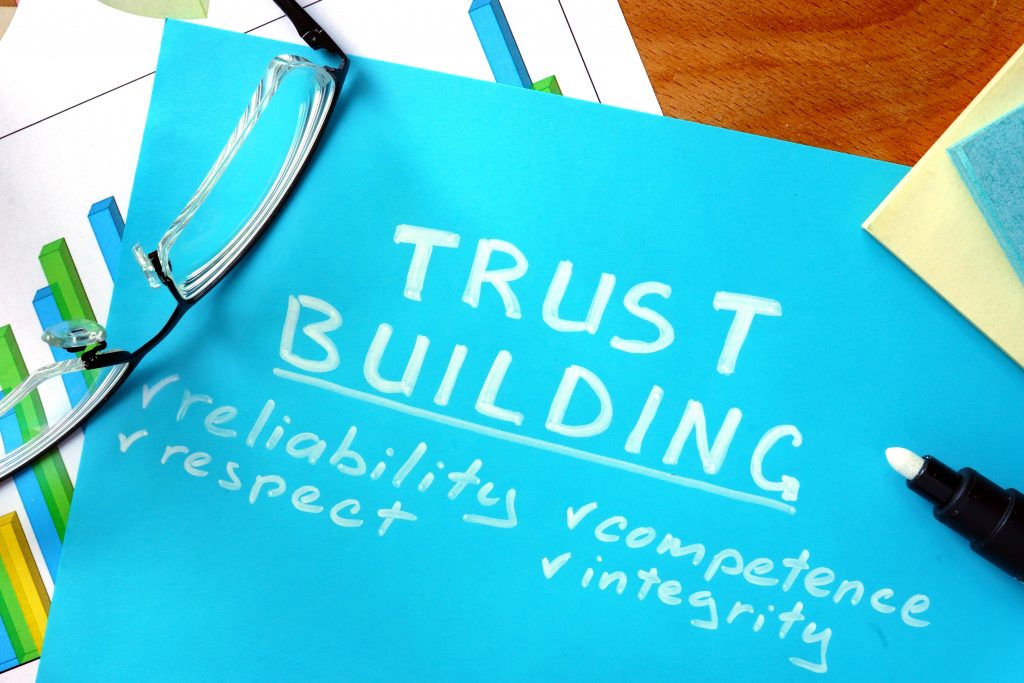
The nine steps to building trust moves your consumer along the trust continuum. (Although the originator of these powerful nine stages is unknown, we’d like to give a big “shout out” to recognize their contribution to building trust online and offline.)

A consumer moves from….

Step 1. Unaware to aware when they view your website, receive a forwarded email from a friend, or read a story about you or your business on social media.

Step 2. Aware to curious when they are touched or affected by the title or content of something you provide.

Step 3. Curious to interested when they discover something you provide that might help them solve a problem.

Step 4. Interested to believing when they begin to deem that your business is legitimate.

Step 5. Believing to wanting when they see what you are offering and want to learn more about your product or service. 

Step 6. Wanting to in-motion when they respond to an offer and reply by phone, email, or social media message. This is a very BIG step.

Step 7. In-motion to buyer when they believe and trust you and your business, want the product or service you provide, and begin to pay you.

Step 8. Buyer to satisfied customer when they are happy with the product or service you provide and their trust in you is rewarded.

Step 9. Satisfied customer to advocate when a the service and benefits continually exceed their expectations. S/he then begins to refer you to others.

Trust is a forward-looking metric and one of the most valuable business strategies for any business to undertake. By systematically building awareness, trust, and confidence across the stages of trust development, you can solidify your business network immediately using this little-known business strategy.


business growth through social media

Understanding the vast extent of social media’s penetration into our daily existence is truly astounding. It seems not that long ago, we were fully engaged in face-to-face interactions, sharing thoughts and laughter in person. We took the time to write letters, carefully choosing our words, sealing them with a stamp, and sending them off with a sense of anticipation for a reply. We were also tethered to phones fixed to our walls, waiting for that ring that connected us to someone far away. (Yikes! I’m showing my age.)

The rapid transition to digital communication highlights not just technological advancement but also a shift in how we connect with others.

As we’ve traveled through time, the tactics employed in social media have evolved dramatically. Remember the trend of sharing your meal photos on Twitter? It was all the rage until suddenly, it wasn’t. Additionally, we discovered countless applications for social media, extending far beyond our initial imagination—reigniting old connections, sharing news of global events, and bridging the gap between consumers and the services they seek. Most of the applications have been and continue to be astonishingly beneficial; some have proven to produce dreadful outcomes. 

business growth through social media

The benefits social media has introduced are undeniable. However, it seems as though businesses began to lean a little too heavily into their success, transitioning from authentic, human interactions to a more automated engagement relying on minimal effort rather than a genuine attempt to build trust and a true relationship.

When considering today’s digital interactions, engaging with an automated system can feel significantly less personal, like chatting with a robot. And, the missing piece of personal interaction diminishes the effectiveness of communication, making it harder to form meaningful relationships.

Automation within social media certainly plays a critical role. It simplifies and streamlines tasks, particularly for small business owners lacking a social media team or a tech-savvy individual to manage their content consistently.

If You Build It, Will Business Growth Follow?

Sadly, this isn’t quite the reality. Many small business owners have learned this the hard way, starting a business page on Facebook or IG expecting an immediate influx of followers and customers. Merely promoting your services won’t suffice. “Social” media is meant to foster social interactions, making engagement crucial.

Engaging in meaningful conversations and directing your communication toward your audience is the key to driving website traffic, generating leads, securing clients, or boosting sales.

Social media serves as a tool to facilitate dialogue and interaction, aiming to build and nourish relationships rather than replace them. Hence, the essence of leveraging social media effectively is to engage with your audience.

Share content that sparks conversation, respond to comments, ask questions, and participate in discussions. Show genuine interest in your followers’ lives and interests. This approach builds a community around your brand or profile, leading to stronger, more meaningful connections.

View social media not merely as a channel for broadcasting but as a vibrant, interactive space where real conversations unfold. Engage authentically with others, and you’ll experience firsthand the transformative power of social media in fostering lasting relationships.

mobile business growth

In an ever-evolving business landscape, small businesses are on the brink of a revolution filled with abundant opportunities. With consumers constantly on the go, armed with their smartphones, tablets, and laptops, the question at hand is no longer why but how quickly can you align your business with the changing client needs and burgeoning mobile trends.

The Imminent Mobile Surge and Its Implications

Upwards of 50% of small businesses are placing mobile marketing at the core of their strategic initiatives. Consider these updated numbers for 2023 on mobile trends and shifting client needs:

  • B2B clients are actively engaging with reviews on mobile devices, with a notable 60% engagement rate (Source: Forbes).
  • Furthermore, an impressive 75% of internet searches are now conducted on mobile devices, reflecting the growing importance of mobile in the B2B landscape (Source: SEO Reseller).
  • Additionally, 58% of B2B customers are utilizing mobile devices for product insights and comparisons, underlining the need for mobile-optimized content and experiences (Source: SVM Solutions).
  • Moreover, as B2B transactions increasingly shift online, 60% are streamlining the purchasing experience through mobile devices (Source: Qualtrics).
  • This trend is further evidenced by the surge in mobile purchases, with forecasts reaching the $200 billion mark by 2023, as per Forrester.
  • A striking 70%  of B2B clients lean towards text and mobile channels, with a preference for these modes when it comes to inquiries and support (Source: Constant Contact).
  •  65% of customers now expect tailored mobile offers based on their preferences (Source: Textline).
  • Over 80% of clients value immediate responses to their queries via text messages. (Source: Avochato).
  • The trend continues as 55% of consumers prefer text communication over calls for customer service. About 30% prefer text over email.  (Source: Quiq).

These are staggering statistics!

mobile business growth

Deciphering the Mobile Enigma

A strategic pause is warranted before hastily jumping onto the mobile marketing-engagement bandwagon. Having a mobile presence isn’t just about tools—it’s about carving out a strategy that puts the client at the forefront of your business outreach.

To determine the right course for your business, initiate this strategic probe:

  • What business goals would your mobile strategy support?
  • Are there untapped opportunities your business is missing without a mobile strategy?
  • Are your ideal customers finding you on mobile platforms?
  • What percentage of your clients prefer a different method of connection?

Questions like these are not just inquiries; they are your lighthouse guiding you through the fog ensuring you arrive at the best choice for your business and its clients.

A Rundown of Must-Have Mobile Marketing – Engagement Tactics

Here are some of the opportunities to make sure you have in place to optimize your mobile marketing-engagement tactics.

  1. Responsive Website: Google’s Mobile Optimization Guidelines state that anything less than a website that seamlessly adapts to varying platforms—be it a phone or desktop—is a compromise too expensive. Unoptimized businesses risk plummeting in SEO rankings or vanishing from search results altogether.
  2. Responsive Email and Content: Mobile commands a massive 72% of internet usage. It’s only logical for businesses to ensure every customer interaction is mobile-friendly.
  3. Tailored Mobile Content: Forbes champions “micro-moment” optimization of content, guaranteeing richer engagement and sales.

The essential “micro-moments”:

  • I-want-to-know (e.g., “Capital city of Nevada?”)
  • I-want-to-go (e.g., “Closest Thai restaurant?”)
  • I-want-to-do (e.g., “Steps for French press coffee?”)
  • I-want-to-buy (e.g., “Leather messenger bags”)

From a business perspective, I might add:

  • I-want-to-overcome (e.g. “sluggish growth?”)
  • I-want-to-achieve (e.g. “business growth?”)
  • I-want-to-find (e.g.”good talent?”)
  1. Location-based Keywords: Like a trusted friend, Google suggests “near me” after many searches. Capitalize on such intelligent prompts by integrating location-based keywords into your SEO strategy.
  2. SMS Marketing: An avenue with a staggering 98% open rate, this channel far outpaces traditional email marketing and demands your attention.
  3. Mobile App Phenomenon: A Gallup study reveals that 72% of Americans check their phones at least hourly, with apps being their touchpoint. Entering the app domain isn’t just an option—it’s a competitive imperative.
  4. Mobile Payments: Stride alongside innovations such as Apple Pay and relish the efficiency it brings to transactions.

Mobilizing Your Business Growth for Tomorrow’s Success

The decision to adapt to mobile is no featherweight one. It’s about crafting an experience that resonates with a mobile-centric audience. Your mission? To forge interactions that are not just transactions but journeys enriched with technology and convenience.

Today’s small business owners stand at a crossroads between traditional operations and futuristic possibilities.

Embracing the mobile wave isn’t just about staying relevant; it’s about ambitious growth, tenacious innovation, and, ultimately, unwavering customer satisfaction. 


business growth

business growth

Business growth isn’t what it used to be. Gone are the days of being everything to everybody. Yet, despite that, some business leaders tout the benefits of being a generalist. 

I see advantages for both the generalist and the specialist. 

For instance, a generalist doesn’t necessarily develop the same blind spots as someone specializing in a specific industry. Being a generalist can be beneficial in the case of someone like me who consults and coaches small businesses. I can think outside the industry, which can bring a unique perspective not previously considered. On the other hand, marketing as a generalist has its drawbacks and can make it a bit more challenging to proliferate. 

Growing more quickly is where being a specialist can shine. With marketing and messaging confined to one industry, it becomes easier to gain traction. 

Even as a specialist, focusing on a niche is no longer enough to break into the world of big profits. Instead, in today’s marketplace, a business needs to specialize in a micro-niche to optimize success

Defining Micro Niche

Most people in the world of business know what a niche is. Sports cars, fitness, health—each of those is a niche. But if you ever crack open a laptop or scroll through your Facebook newsfeed, you can attest to how many professionals focus on those general industries.

Concentrating on a micro-niche can set you apart and make a significant impact. For example, instead of focusing your brand on general fitness, specialize in fitness for teen girls or women over 60. Those are micro-niches. 

Here are a few more examples:

  • Tiny houses: micro-niche in the real estate industry
  • European travel: micro-niche in the travel industry (Or niche down further by honing in on travel to Germany.)
  • All-natural makeup: micro-niche in the skincare industry

Benefits of a Micro Niche for Business Growth

Micro-niching, and its many benefits, is exciting. But, unfortunately, it can also be a bit unnerving. 

One of the greatest fears for most small business owners when they consider streamlining services to a more specific area, is the loss of potential clients. Is that possible? Emphatically no! I’ve witnessed this in my coaching practice. The opposite is true. When my clients began the process of niching down, their revenue experienced a substantial jump. 

Take a look at the benefits that prove micro niches lead to business growth:

  • Low competition. Because of the highly specialized nature of the micro-niche, you have minimal competition. 
  • Ability to gain traction. Every business needs momentum to get started and continue growing. A micro-niche provides the traction required to progress quickly, so you’re not spinning your wheels.
  • Increased profitability. Due to low competition, you naturally experience greater profits because you have access to more clients who share your interests, desires, and passions. (Plus, think of how much fun your business would be if you worked in a highly specialized area that you love.)
  • Easier marketability. Marketing experts know that standing out in a crowd is the key to drawing attention to your brand and increasing sales. A micro-niche makes this possible and leads to an increase in business growth.

Finding Your Micro Niche

Okay, now you know the importance and benefits of micro-niches. Are you ready to make the switch? If so, how do you find your micro-niche?

Let’s say you’re a fitness expert. How do you stand out from the millions of other fitness experts in the market? Here are the first two questions to ask yourself on your journey toward micro-niche business growth.

  1. What is my greatest passion?
  2. With whom do I most enjoy working? (Read Buyer Persona: The Ultimate Tool for Small Business Success in a Crowded Market.)

Once you’ve answered those two questions, you’re well on your way to identifying your perfect niche fit.

What is the “tiny house” of your market? Give us a call when you’re ready to find out—and micro-niche your way to business growth and success. You’ll be up and growing in no time.

business moments of truth

Before the introduction of business technology, the traditional marketing model remained unchanged. This reduced consumer choices.  Marketing opportunities to learn about competing products or services were limited.

business moments of truthBefore the digital revolution, we may have heard about a product from advertising on TV, radio, or newspaper. (Remember those?) However, to experience the product or service, we made our way to a brick-and-mortar establishment. It was only at that point that comparison shopping took place.

Today, the consumer’s purchasing journey is an entirely new game. With the onset of technology, and the inception of digital marketing, 81% of today’s consumers conduct research online before their final buying decision.

In 2011, Google conducted a study ascertaining the number of sources of information consumed before making a purchase. At that time, an average of 10.4 sources was consumed from first viewing an ad to the product purchase. By 2015, that number had doubled to an average of 22 references. 

The information available digitally for today’s consumer is so complete that most consumers make their purchasing decision well before entering a store or clicking “add to cart.”

What does this mean for your business?

By taking charge of the moments of truth in your business, you can be among the 20+ pieces of information that consumers consume on their way to their purchasing decision.

Moments of Truth: Today’s Map for Business Marketing

Moments of truth can seem insignificant to a small business owner when they’re happening. Clients, however, have an entirely different reaction. For instance, if a potential client calls you and you don’t give them your full attention because of an office distraction, their impression may be that you are unfocused, unprofessional, and perhaps unworthy of their business. Situations like this can spell disaster for any business.

So, what’s a moment of truth?

A moment of truth is a sliver of time when clients or prospects interact with your business and decide whether or not to do business with you, share you with their network, or use your products/services again

Jan Carlzon, in his book, Moments of Truth, defines them as “anytime a customer comes into contact with any aspect of a business, however remote, [as] an opportunity to form an impression.”

Some of the everyday moments of truth include:

  • When a person hears someone else praise you or your work.
  • When a person likes your physical presentation, including your website, appearance, handshake, voice, or smile.
  • When a person is touched intellectually and emotionally by what you say.
  • When a person recognizes you as a model of whom or what they would like to become.
  • When a person experiences you are consistently excellent technically.
  • When a person knows you care.
  • When a person feels they and their information are safe with you.
  • When a person trusts your professional credentials.
  • When a person thinks they will be challenged and get what they need from you.
  • When a person pays your fee without any conversation.
  • When a person looks forward to small gifts and thoughtful messages from you.
  • When a person knows you will make it right for them if they have a complaint.
  • When a person knows your fee is slightly above the industry standard and feels you’re worth it.
  • When a person is sure that their success and well-being are your priority.
  • When a person knows you never stop growing professionally.
  • When you ask a person to tell you their expectations and frustrations about the service you provide.
  • When a person knows you have designed your business around what’s convenient for them.
  • When a person can reach you effortlessly.
  • When a person can count on you to treat them as a unique individual with unique needs.
  • When a person knows you will remember their kids’ names and send them a card on their birthday.

Strengthening the moments of truth in your business ensures your clients remain on the continuum of the nine steps to building trust. The outcome? A measurable increase in client acquisition, retention, and sales.

The Strategic Role in Mapping Your Moments of Truth 

One of the roles of a strategic small business coach is to ensure your business makes the right impression when interacting with clients and prospects. As an advocate for small business owners, a coach provides an objective evaluation that can make the difference between a client passing on your business for one of your competitors and landing that next big sale. 

However, you may ask yourself these common strategic questions to refine how you handle the moments of truth in your business. 

  • What are the various touchpoints of our business, such as your Web site, meeting at a networking event, sending an email, or leaving a voicemail message during which a potential client develops an impression?
  • What is the current impression our clients and prospects experience?
  • What is our intended impression? Where are the gaps?
  • What changes ensure each impression is the one we want our client to experience?
  • Who will make those changes?
  • When will those changes be made?
  • How will we measure the effectiveness of your changes?

Analyzing your moments of truth bring clarity to your business.  And, with the right strategies you can create impressions to turn the most skeptical prospect into your company’s most enthusiastic advocate.

achieve business growth by ridding self of tolerations

It’s a jungle out there, especially when understanding the terminology to market your small business. A misunderstood term or misapplied could blow a big deal with a critical client. Egads!

What’s worse than not knowing a vital marketing phrase? Of course, that would be not using the correct lingo at the right time! In a nutshell, it makes you look like an amateur

small business marketing

The Entrepreneur, the Manager, and the Technician 

Michael Gerber, the well-known author of The E-myth, spoke of the three personalities who go into business: the entrepreneur, the manager, and the technician.

The entrepreneur sets the vision and does the heavy lifting of strategic thinking. Then, the manager implements the plan laid out by the entrepreneur. And, the technician does the “roll up your sleeves” actual work of the business.

If you’re like most small business entrepreneurs, you’re all three — and a few more! And, you likely spent most of your time working “in” your business as the technician.

What does this have to do with the “jungle jargon”? I’m so glad you asked!

Without a technical background in entrepreneurship or marketing, it’s easy to misuse or misunderstand marketing terminology and tools.

The Small Business Marketing Basics 

Three commonly misinterpreted and misapplied terms are elevator speech, unique selling proposition, and value proposition. Knowing how and when to use each of these terms can influence your business growth rate.

  1. An elevator pitch is one to two sentences about your target audience and your general area of work. Most often used in networking situations to introduce your business, offline and online. The elevator pitch is only a few words long and quickly delivered within 10 seconds.
  2. Your unique selling proposition is a statement of what makes you different. Your USP may be your specialty, methodology, or guarantee and is commonly used when a client is ready to buy.
  3. The value proposition is a marketing statement of the promise of value to be delivered to the potential client. Your value proposition is specific and generally cites numbers or percentages. It also may include a quick synopsis of your work. A value proposition is often used in emails, your website, and conversations with your prospective audience. More than anything, your value proposition indicates why the potential client should buy from you rather than your competition — without ever having to use the name of the competition!

Getting through the business jungle unscathed and in one piece is challenging enough. But, without the right equipment, it can be daunting!

With the right tools at the right time, you’ll quickly cut through the dense, unruly marketing space to grow your business.

business growth

business growth

Your business growth is shaped by consumer behavior. And, as you might have noticed, consumer buying behaviors have changed dramatically. Newspaper ads, circulars, or cold calling are a thing of the past. Consumers no longer have confidence in such methods. So while consumers continue to buy, how they spend their money has changed.

Today, consumers turn to the web for information about companies and products before buying. In addition, 80% of business decision-makers research custom content to learn about service. Busy entrepreneurs prefer this method rather than being bombarded with ads. Sound familiar?

As a result, we need to respond to the change in buying behaviors with fresh ideas that better match consumers’ buying habits.

Enter Inbound Marketing.

Outbound Vs. Inbound Marketing for Business Growth 

The antiquated method of marketing — “outbound marketing” — is based on the principle of pushing products and services on consumers. This strategy is “interruptive marketing.” And, for a good reason. The outbound method interrupts your day with sales calls, unwanted emails, and misplaced ads. (As though you don’t already have enough interruptions.)

On the other hand, inbound marketing improves business growth by attracting consumers to your product or service using content that serves a purpose. Whether that purpose is to inform or entertain, it doesn’t involve selling.

The Attraction of Inbound Marketing 

The basis of inbound marketing is to attract potential clients to your business. However, there’s another factor that makes inbound marketing attractive. An automated inbound marketing strategy allows you to achieve better personal and professional balance as your business grows.

business growthLike me, you likely launched your business to be the boss, including setting your schedule. And, like me, you probably didn’t realize that growing a business required such an extraordinary level of devotion, dedication, and time.

Yet, as entrepreneurs, one of the things we crave most from owning our own business is more time for the people and things we love. That’s where inbound marketing comes in.

Inbound marketing certainly mitigates the time burden of business growth. Instead of being stuck in traffic or schmoozing it up at networking events and business fairs to generate leads, an inbound marketing strategy is automated to work in your absence. This automated process gives you more time for family—and other things you love—while you continue to generate new leads.

What Are You Waiting For? 

Even though inbound marketing saves time and improves lead generation, it doesn’t happen overnight. It takes time to:

  • Define your strategy
  • Identify the elements of your strategy
  • Build the components of your system.

Even once all your ducks are in a row, it takes time to:

  • Build awareness
  • Establish credibility
  • Expand your reach

Patience — and persistence — are key! And the amount of perseverance (and time) depends on many different factors — which is why it’s crucial to start immediately.

It can take 12 to 18 months—or maybe more—to see results at the level you desire. The sooner you begin, however, the sooner you’ll benefit from the fruits of your labor and open doors to your desired client base.

Now that you know the ins and outs of business growth, what are you waiting for? 

business ask

A recent business connection on Linkedin resulted in a fun and insightful conversation. My pen flew across the page to capture how she leveraged the information to get “unstuck” and in motion as we chatted. Enjoy and read the course of action she implemented to break through her resistance to ask.

A small business entrepreneur’s day is filled with opportunities to ask for – and get – what we want—asking leaves some small business owners fearful and hesitant — especially when unaccustomed to their requests being realized. As a result, some small business owners grab hold of the “ask” in a manner that triggers an inability to achieve their quest. 

On the other hand, victorious entrepreneurs seize the opportunity to “ask” and forward their objectives. Why do some entrepreneurs succeed while others fail at asking for and getting what they want? The triumphant entrepreneurs employ “the art of the ask.”

business ask

The Art of the Ask in Your Business

Most small business entrepreneurs are masters of their craft. They are highly skilled in their area of expertise. Their competence may be legal, financial, design, communication, project management, process improvement, technology – the list is endless. Seldom is “the art of the ask” taught at the advanced learning institutions attended.

Consequently, this means using trial and error (i.e., mostly error) to hone their “asking” skills. In contrast, people who ask for and get the “yes” regularly have become skilled at “the art of the ask.”

Does This Make My “Ask” Look Big? 

Asking for and getting what we have in mind isn’t the same. We ask for permission, a referral, the sale, to be paid, for help, approval, an introduction, special treatment. Getting to “yes” depends on the skill and the size of your “ask.” Here are a few pointers to get you closer:

1. Be reasonable. Consider the desired outcome of your ask. Is it directly proportional to your relationship with the supplier of the “yes”?

2. Keep it simple. Research indicates that one (1) reason gets the best results. So, avoid the need to pile on the reasons for someone to do what you want.

3. Draft your request before making it.

4. Be kind/honest/professional. No BS allowed.

5. Be specific and brief. Don’t him-haw around.

6. Provide an easy out. Make it easy for someone to say “no” without damaging your relationship.

7. Show your gratitude.

8. Be willing to give in return.

9. Make it WIIFM compliant. WIIFM stands for “what’s in it for me.” It’s the question that subconsciously goes through the mind of each provider of a “yes.” If your request is WIIFM compliant, your “yes” broker will quickly see that your “ask” imparts something for them as well.

The ability to ask for what you want to increase the likelihood you will obtain it is a crucial business skill. With a bit of practice, you’ll master “the art of the ask.”

Now, go ahead. Ask me anything!

A Brilliant Step by Step Ask

Here are the steps my new Linkedin connection took to overcome her resistance to asking for help:

1. Make a list of people she wanted to contact.

2. Noted her relationship with each. 

3. Identified one “ask” for each. 

4. She considered how to provide an “easy out” if she heard hesitancy.

5. Made the WIIFM (What’s in it for me) crystal clear.

Your turn. What’s your ask?

Every once in a while, you meet a talented, young entrepreneur who shares your values for supporting small business entreprenuers in the realization of their business goals and objectives. Tiffiney Cornish of TC Creatives is one of those passionate — and compassionate — individuals.

During our chat, I was particularly intrigued with her expertise on branding. Here is what she has to say in Branding: What It Is and Why It Is Important, which was originally found at www.tc-creatives.com.


One common misconception about branding is that it is the same as design. And while design is the visual representation of your brand, it is only an element of your branding. Lately the word “branding” is viewed more like buzzword than a staple part of starting a business.

However, branding is a significant part of your business development. It should be highly prioritized when starting a new company. Your branding will influence how your company does against competitors when it enters the marketplace.

What is branding?

Branding is the practice of creating a name, symbols, or designs that represent who you are, why you are, and how your target audience should perceive you. Its purpose is to differentiate your company from its competitors and clearly display the promises that you make to your customers.

The branding process includes research that helps develop a strategy of how to present your brand to your target audience. This research is then used to create assets that support your brand promise and appeal to your customers.

Doing brand research.

Brand research helps define exactly what you intend the brand to be. It is an essential step that should be done prior to developing any elements to market to your customers. This research ensures that the assets you create attract the most qualified buyer for your products and services.

The two types of research that you should do when building a brand are:

Market Research
Market research is the process of finding information about the competitive market you are entering. You should know who your competitors are, what they offer, how much they are charging, and what unique benefit you can offer to your customers that they cannot. This helps define your company’s value proposition.

Customer Research
Customer research is the process of finding information about people who are currently purchasing products and services similar to yours. When doing product research you should determine what customers are looking for in a product, what they are not receiving from the current provider, and how they will value what you offer.

Developing your branding.

Your company’s branding includes a complex set of assets that collectively establishes a relationship with your customers and defines your values. These assets should be deliberate and consistent.

The following assets are part of your branding:

Brand Message
Your brand message is the value that you offer to your customers. This is what makes people relate to your brand and influences them to buy from and follow you.

Brand Tone
Your brand tone is the tone of voice that you want to use when communicating with your customers. It is a representation of your brand’s message. The tone used for your branding will influence how your target audience thinks of and interacts with your brand.

Brand Name
Your brand’s name is the first thing a potential customer hears in reference to your company. It should be strategically developed to clearly define what you do and who you do it for. A customer should not have to guess what your company is about when hearing your name.

Color Palette
Understanding how color effects emotion allows you to capitalize on the emotional elements of sales. Color is one of the first things that your brain perceives. It will influence the customer’s reaction to your product or service before they learn any detailed information about it. The colors for your brand must be consistent with how you want your customer to feel when they see your brand.

Typography
Typography is the art of arranging type. The fonts you use when branding your company will heavily influence how your message will be perceived. They must be consistent with the tone of your brand.

Logo
A logo is the symbol used to visually represent your products and services. It should incorporate all of your branding elements. Your logo should be a clear, distinct symbol of your brand.

Brand Collateral
Brand collateral is the media, usually printed, that you use to promote your brand. Business cards, flyers, direct mailers, and product labels are all brand collateral. These are used to strengthen your brand’s message and tone, and generate customer leads.

Website
Your website is your strongest marketing tool of all. It incorporates all elements of your branding to generate a stronger brand presence in your industry. It is your global voice as it is the most accessible asset you will have worldwide.

Why branding is important?

Branding is important because it makes your brand relatable to your customers. It also creates credibility for your company. Your branding will influence the success your company has in its target market. It takes 5-7 impressions for your brand to become recognizable to the customer (Action Card). If your branding is inconsistent, even a little, your brand value and message may become lost in your marketing. This will make it harder to produce brand loyalty.

Having strong branding allows the customer to build a connection with you that they can trust. 90% of purchases are made subconsciously (ISPO News). Once you have secured a place in the customers mind, it is easier to close a sale.

The colors that you choose for your branding significantly impact your brand recognition. A staple color increases brand recognition by 80% (University of Loyola).

The strength of your branding plays a huge role when trying to secure funding for your company. 82% of investors see brand strength as an important factor when deciding on an investment (Reuters).

How strong is your branding?

If you did the necessary research prior to starting your brand development, your branding should be generating sales and producing customer loyalty. However, if you are like many entrepreneurs starting, you may have overlooked a step or two. Don’t worry, it’s never too late to rebrand.

Branding is something that has to be monitored actively to ensure that it is effective. Just like the customer, it evolves and you must evolve with it. Well known companies like Coke-a-Cola and Starbucks have all rebranded at some point or another when their branding no longer reflected their direction or reached their valued customers.

Invest in researching, defining, and developing your brand. Full-service agencies ensure consistency within your development and design processes. They are capable of creating all of the elements seamlessly, while being able to monitor the impact that it has on your sales. Because they help create your strategy, they understand your goals and are able to help your brand pivot without losing the company’s core values.

In conclusion, great branding leads to loyalty and sales. Don’t sell yourself short.

Who hasn’t banged their phone on their desk while being rerouted through a tortuous telephone tree currently known as “customer service.” Press 3. Enter your pin. Follow with the # sign. Ugh!

Today’s consumer needs are evolving. They have greater power and are no longer at the mercy of business. In fact, they are most interested in experience — not things.

They want clarity and transparency — nothing vague. Plus, they want the same experience across every touch point (i.e., website, social media, print, customer support, etc.) And, if it’s instantaneously, that’s even better!

Is this your small business customer service experience?

describe_customer_service_experienceConsumers Willing to Pay More for Good Experience

Have you noticed your loyalty shift based on your experience as a customer? Whether you’re shopping for groceries, eating dinner out, having your automobile serviced, or mailing packages, you’ve likely noticed a change in the businesses you’re willing to support.

Here is one simple example from my own experience.

My behavior — and loyalty — swayed from the bureaucracy of the United States Postal System (USPS) to a local, small Mail ‘N Ship store this past year. Why?

The staff at the local mom-and-pop store always has a smile on their face! They keep the line moving, are cordial, make eye-contact when speaking with you and, best of all, they know my name and use it the minute I walk in the door.

Some of the USPS front-line employees are cordial, friendly, and do the best they can. Sadly, the USPS culture is notoriously plagued with inefficiencies, long-lines and, if an employee is having a bad day, they can be merciless.

Could USPS create the same experience? Absolutely!

Shipping costs at the mom-and-pop store are more expensive but that’s not reflective of the experience they provide. Costs are higher because of overhead. It doesn’t cost extra to create a positive experience that keeps customers coming back.

Customer experience goes beyond customer service.

small_business_customer_experienceDescribe Your Customer Experience

How do you want your customers describing their service experience? Understanding what today’s consumer wants is an ideal place to begin:

  1. Personalization. This can be a bit of a challenge but “one size fits all” is no longer going to cut it. Marketing software developments and automation make it much easier to achieve the level of personalization your consumer desires.
  2. Options to reach you. Your consumer wants to select the method that best meets their needs — not yours — to contact you.

Watch for website chat to grow this year as 43% of consumers prefer an immediate answer to their question while browsing your website. Only 18% of consumers are interested in self-service. Cover all your bases with online and offline options available.

  1. Continual contact. As more consumers unsubscribe from email newsletters, unfollow your social media platform, and block your mobile marketing texts, this seems a bit counterintuitive. However, consumers define what they want to hear, where, and how often. Be sure to give them options.
  2. Listen/respond. Ask your consumer to rate you on your service and what do you get? Crickets! Nothing is more annoying and time consuming for your customers than taking senseless surveys.

To get their attention — and valuable input — speak directly with your client. Then, reward them by implementing their ideas and a $50 Amazon gift card for giving of their priceless time and insight.

Undoubtedly, it’s challenging to look from the inside out to see how your business stacks up. Plus, it can be tough to hear unflattering feedback. Yet, the loyalty provided by someone who describes your customer experience as stellar places your business at a greater advantage.

Are you ready to uncover the moments of truth for your business?

Core Business Assessment

Testimonial

Brooke Billingsley

Vice President
Perception Strategies

Synnovatia is a strategic coaching firm that is detailed and knowledgeable about business. i have a small business that grew from $150K to $750K because of the goal setting and resources that Synnovatia provided. It saves me years of learning on my own.

Search The Blog